In this project, I built a convolutional neural network to classify fruit images by category. The experiment explores image preprocessing, data augmentation, and model evaluation; quality grading and real-time deployment are outside its scope.
Manual sorting and inspection of produce is a labor-intensive process that can introduce inconsistencies and errors. By leveraging modern deep learning techniques, computer vision systems can automatically classify products and help improve operational efficiency in supply chains.
The project focuses on learning visual features with a CNN and checking how well those features generalize to unseen images.
Table of Contents
- Project Overview
- Dataset Overview
- Deep Learning for Image Classification
- Model Architecture
- Image Preprocessing and Training Pipeline
- Model Evaluation
- Results
- Scaling and Production Considerations
Project Overview
Context
In produce warehouses and grocery distribution centers, fruits and vegetables are typically sorted manually based on visual inspection. This process can be time-consuming and prone to human error, particularly when dealing with large volumes of products.
Automated visual inspection systems can help address this challenge by using computer vision models to identify products based on their visual characteristics.
In this project, I built a deep learning model capable of classifying fruit images into different categories, demonstrating how computer vision can assist in automated product recognition.
The objectives of the system are to:
- Identify fruit categories from images
- Learn visual features such as shape, color, and texture
- Automatically classify new fruit images with high accuracy
- Demonstrate how deep learning models can be applied in food supply chain automation
Dataset Overview
To train the model, I used a labeled image dataset containing images of various fruit categories.
Each image represents a single fruit instance photographed against a neutral background. The dataset includes multiple fruit classes such as apples, bananas, oranges, grapes, pears, and strawberries.
The images vary slightly in lighting conditions, orientation, and fruit appearance, allowing the model to learn robust visual features.
The dataset was divided into training data, validation data, and testing data. This split ensures that the model can generalize well to unseen images.
Deep Learning for Image Classification
Image classification is one of the most widely used applications of deep learning.
Instead of manually defining visual rules for identifying objects, convolutional neural networks automatically learn hierarchical visual features from data.
These networks detect increasingly complex patterns through multiple layers:
- Early layers learn simple features such as edges, color gradients, and textures
- Intermediate layers detect more complex structures such as curves, shapes, and contours
- Deeper layers learn high-level semantic features that allow the model to distinguish between different fruit types
Model Architecture
For this project, I implemented a convolutional neural network (CNN) for fruit classification. The model consists of several components:
Convolutional Layers These layers extract spatial features from the images using learnable filters that detect patterns such as edges, textures, and shapes.
Activation Functions Nonlinear activation functions such as ReLU allow the network to model complex visual patterns.
Pooling Layers Pooling layers reduce the spatial dimensions of feature maps while retaining the most important information. This helps improve computational efficiency and reduces overfitting.
Fully Connected Layers After feature extraction, the feature maps are flattened and passed into dense layers that perform the final classification. The final output layer produces probabilities for each fruit class, allowing the model to determine the most likely category for the input image.
Image Preprocessing and Training Pipeline
Before training the model, I implemented an image preprocessing pipeline that performs the following steps:
- Resize images to a consistent input size
- Normalize pixel values
- Convert images into numerical tensors
- Organize images into training batches
Data augmentation techniques were also applied during training to improve generalization, including random rotations, horizontal flips, and slight scaling transformations.
Data augmentation helps the model learn more robust features by exposing it to variations of the training images.
The model was then trained using a supervised learning approach where the network learns to minimize classification error across the labeled training dataset.
Model Evaluation
The baseline learning curves below show training loss approaching zero while validation loss stays higher. The gap is a reminder to assess generalization, rather than relying on training accuracy.
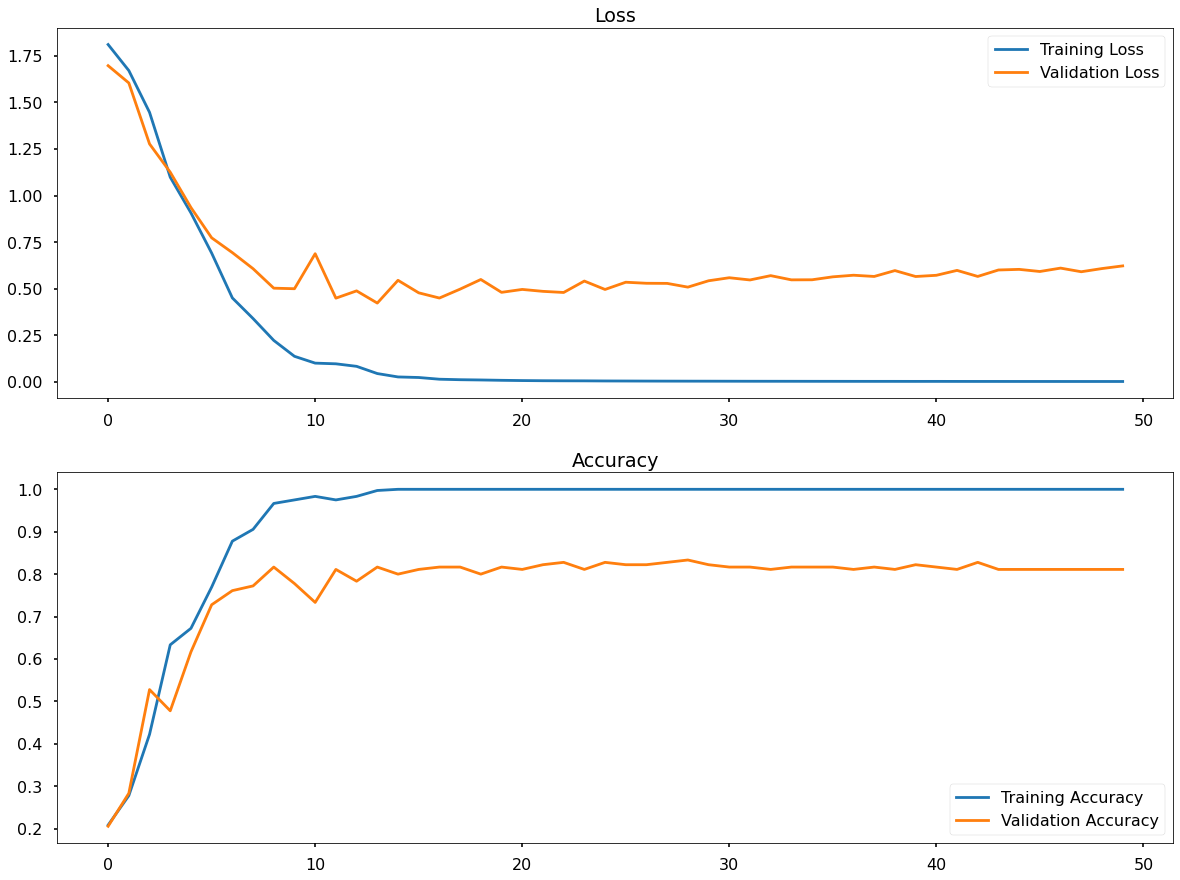
To evaluate the performance of the model, I monitored several key metrics during training:
- training accuracy
- validation accuracy
- training loss
- validation loss
These metrics help determine whether the model is learning effectively and whether overfitting occurs.
The final model was evaluated using a held-out test dataset, ensuring that performance metrics reflect the model’s ability to generalize to new images.
Results
After training, the model achieved high classification accuracy on the test dataset, demonstrating its ability to correctly identify fruit categories from images.
The model successfully learned to distinguish between fruit types based on visual features such as shape, color patterns, and surface texture.
The results show that convolutional neural networks are highly effective for image-based product classification tasks.
Scaling and Production Considerations
While this implementation serves as a proof of concept, several improvements could be made to deploy this system in a production environment.
Transfer Learning with Pretrained Models
Modern computer vision systems often leverage pretrained architectures such as ResNet, EfficientNet, and Vision Transformers. Using pretrained models can significantly improve accuracy and reduce training time.
Real-Time Inference Systems
For warehouse applications, the model could be deployed as part of a real-time inference pipeline connected to camera systems on sorting lines:
Camera Capture
↓
Image Preprocessing
↓
Deep Learning Inference
↓
Product Classification
↓
Sorting System Integration
Edge Deployment
To reduce latency, the model could be optimized and deployed on edge devices located directly within warehouses using technologies such as TensorRT, ONNX Runtime, or NVIDIA Jetson. This would allow the system to perform real-time classification without relying on cloud infrastructure.
Conclusion
In this project, I developed a deep learning–based computer vision system capable of classifying fruit images using convolutional neural networks.
The system demonstrates how computer vision can automate visual recognition tasks in supply chains and retail environments, reducing reliance on manual inspection.
Future improvements could include incorporating transfer learning with modern architectures, real-time deployment pipelines, and edge inference optimization, enabling the system to operate efficiently in large-scale warehouse environments.